 Arrival Guides

# Arriving in Tangier: A Local Guide to the Airport, Transport and Your First Day in the City
Practical advice for first-time visitors to Tangier, Morocco — updated October 2026
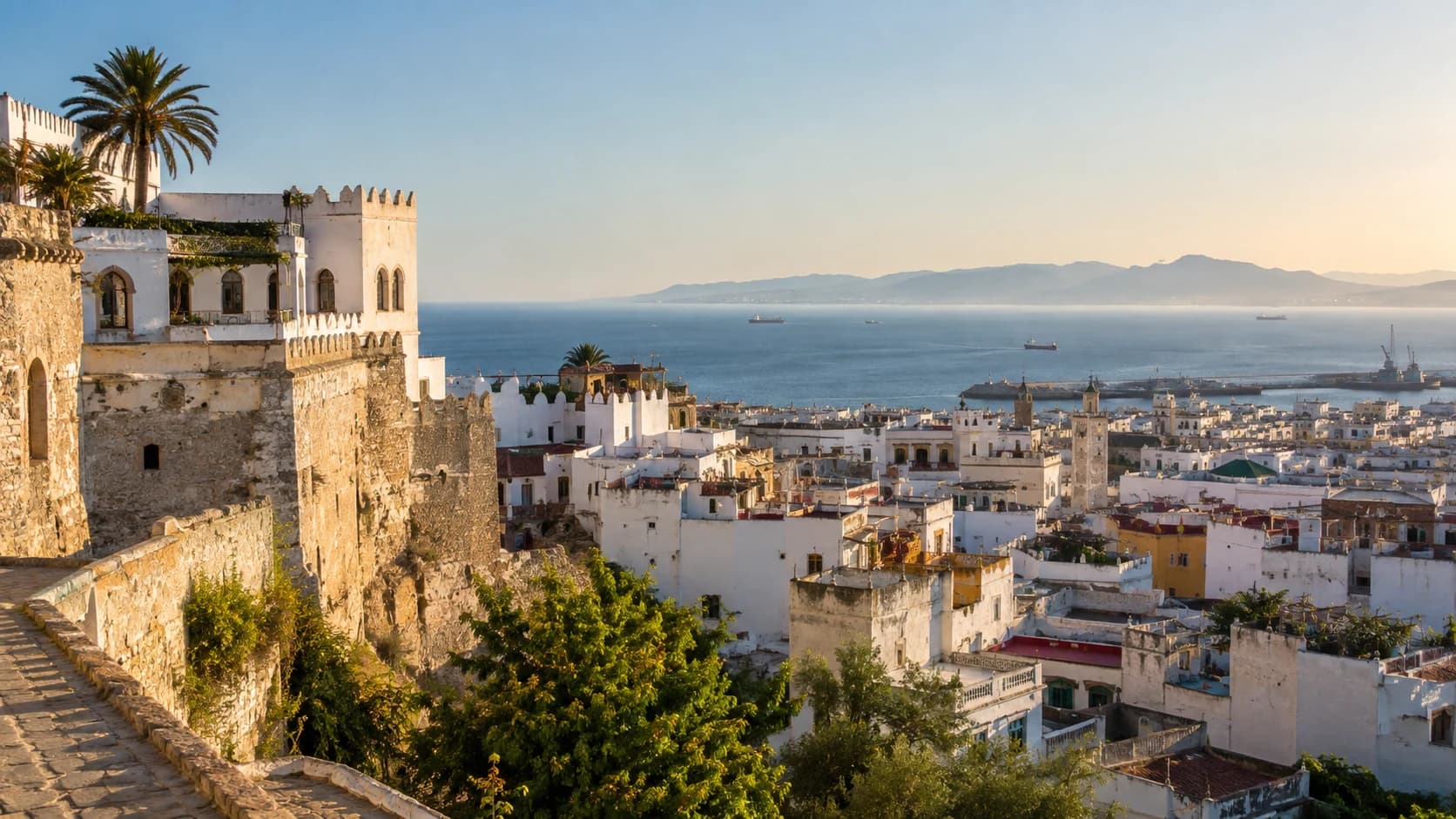
Tangier is an interesting place to arrive in Morocco. On one side, you have the Atlantic Ocean. On the other, the Mediterranean. Spain is just across the Strait of Gibraltar, and the city itself is a mixture of old neighborhoods, busy modern streets, cafés, beaches, and hills overlooking the sea.
For many visitors, Tangier is their first stop in Morocco. Others land here before continuing to Chefchaouen, Tetouan, Asilah, or somewhere further south.
The airport is fairly close to the city, so getting to your hotel is usually straightforward. Still, there are a few things worth knowing before you land, especially if you're arriving late, staying inside the old Medina, or planning to travel directly to another city.
This guide covers what happens after landing at Tangier Ibn Battouta Airport, how to get around, what to expect with taxis, where drivers can meet you, and a few local details that can make your first day easier.
1. Getting to Know Tangier Ibn Battouta Airport
Tangier's airport is officially called Tangier Ibn Battouta Airport, with the airport code TNG. It's named after Ibn Battouta, the famous Moroccan traveler who was born in Tangier in the 14th century.
The airport is located in the Boukhalef area, roughly 15 km by road from central Tangier.
Unlike larger airports such as Casablanca Mohammed V, Tangier Airport is relatively manageable. You won't have to navigate a huge network of terminals or take a train just to reach the exit.
After landing on an international flight, you'll normally go through passport control, collect your luggage, pass through customs, and then enter the public arrivals hall.
How quickly you get through depends on several things: how many flights have arrived around the same time, passport control queues, and whether you've checked luggage.
Sometimes everything moves quickly. Other times, you might spend quite a while waiting. It's better not to make plans based on being outside the airport ten minutes after your flight lands.
A useful tip: If someone is collecting you, send them your flight number rather than just your arrival time. That way, they can check whether the aircraft is running early or late.
2. What to Do Before Leaving the Airport
Once you've collected your bags, there are three things worth checking before heading outside.
Make sure your phone is connected
Having mobile internet makes arriving in a new city much easier.
You'll be able to contact your accommodation, open maps, send your location, and communicate with your driver if needed.
Morocco has several mobile operators, including Maroc Telecom, Orange, and inwi. Visitors can purchase local SIM cards or arrange a compatible travel eSIM before departure.
If you're relying on roaming, check the rates before switching it on. International roaming can be surprisingly expensive.
You can also use airport Wi-Fi when available, although having your own connection is more convenient once you leave the terminal.
Have some Moroccan dirhams
The local currency is the Moroccan dirham, usually written as MAD or DH.
Cards are accepted in many hotels, restaurants, and modern shops, but cash remains useful for taxis, smaller cafés, local markets, and everyday purchases.
You don't necessarily need to exchange a large amount at the airport. Having some smaller notes is enough to get started.
If you're taking a taxi, ask whether card payment is possible before getting into the vehicle. Don't assume every driver has a card terminal.
Double-check your hotel address
This sounds obvious, but it's particularly important in Tangier.
Some hotels have very similar names. Others are located in small streets that aren't immediately obvious on a map.
And if you're staying in a traditional riad in the Medina, your accommodation might not be accessible directly by car.
Save the hotel's full name, address, and phone number. A Google Maps pin can also be useful, but for a Medina property, it's worth asking the hotel which entrance or meeting point they recommend.
3. How to Get from Tangier Airport to the City
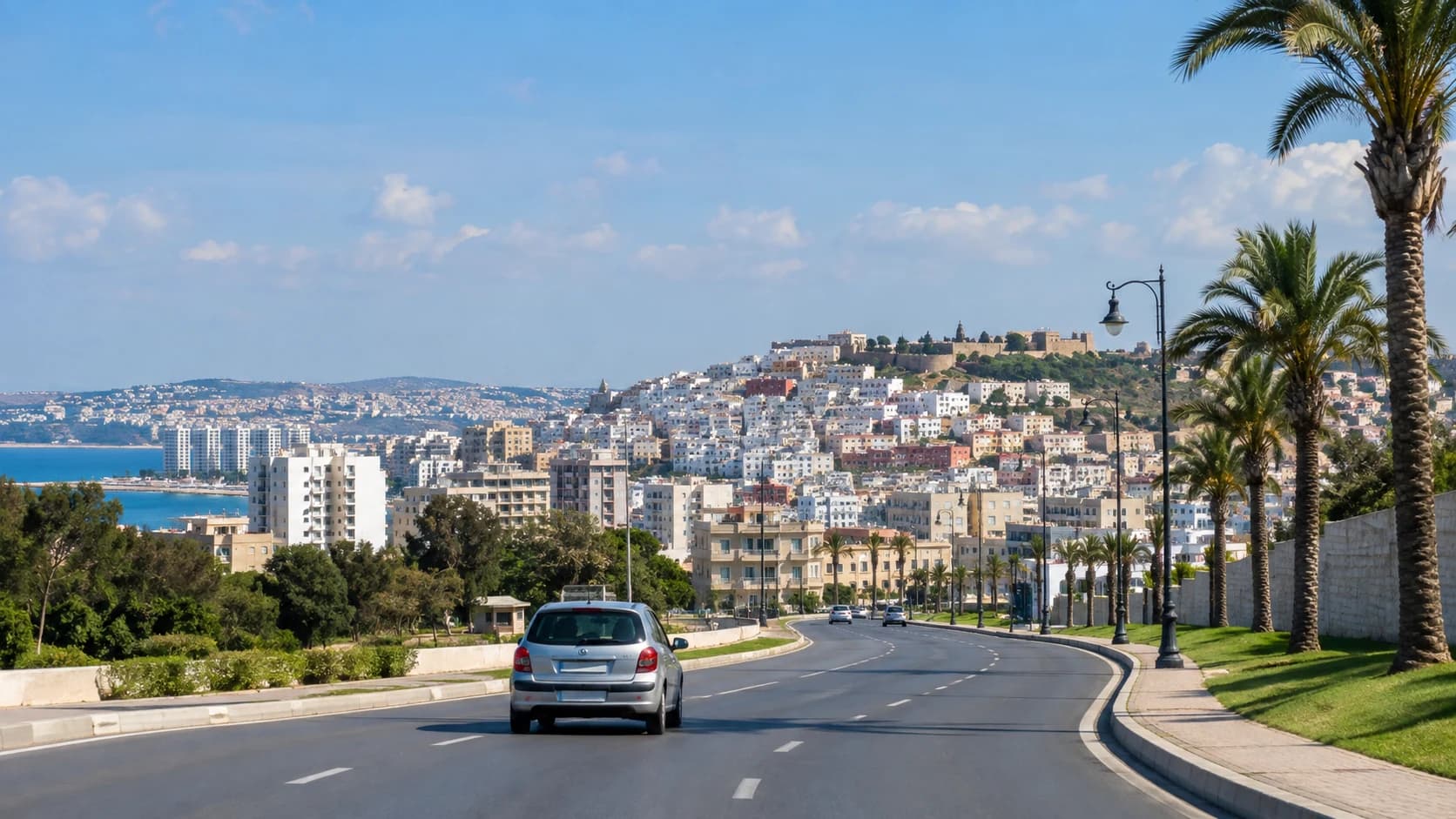
The airport is usually around 20–30 minutes from central Tangier by car, depending on traffic and your exact destination.
There are several ways to make the journey.
Option 1: Official airport taxis
Official taxis are available outside the airport terminal.
These are a practical choice if you're traveling with manageable luggage and haven't arranged transport in advance.
Tangier Airport displays official grand-taxi fares on a board at the terminal. The photo below shows the posted prices and night-fare notes. The fare depends on your destination, so confirm the printed amount at the airport counter before setting off.
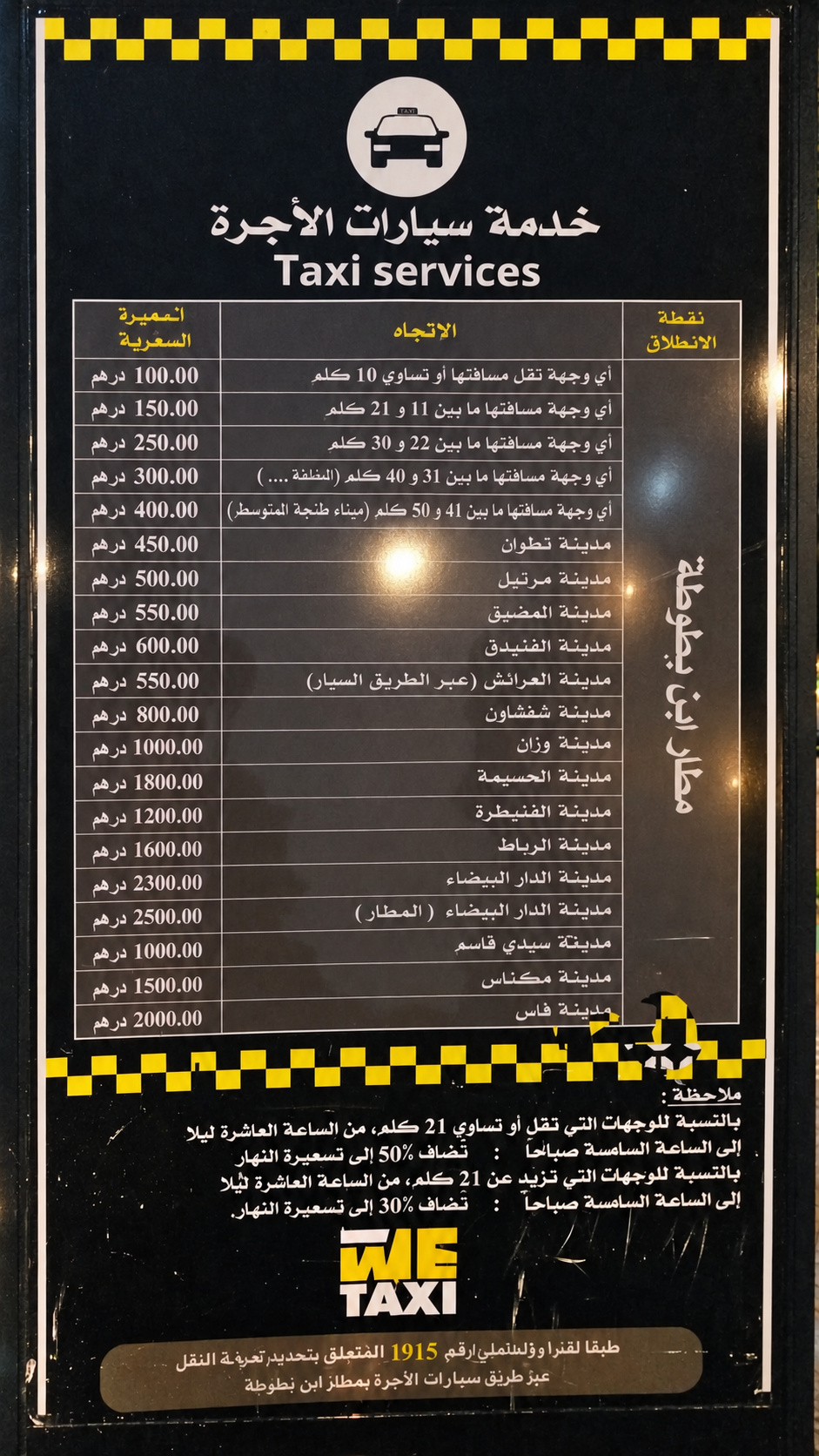
These are official grand-taxi fares, not private transfer prices.
It's a good idea to confirm your destination and total fare with the driver before the journey begins, particularly if you're traveling to an accommodation outside the usual city areas.
Option 2: Pre-booked private transport
Another option is to arrange a driver before arrival.
This is often convenient for visitors arriving late, families with children, groups with several suitcases, or anyone traveling to a destination outside Tangier.
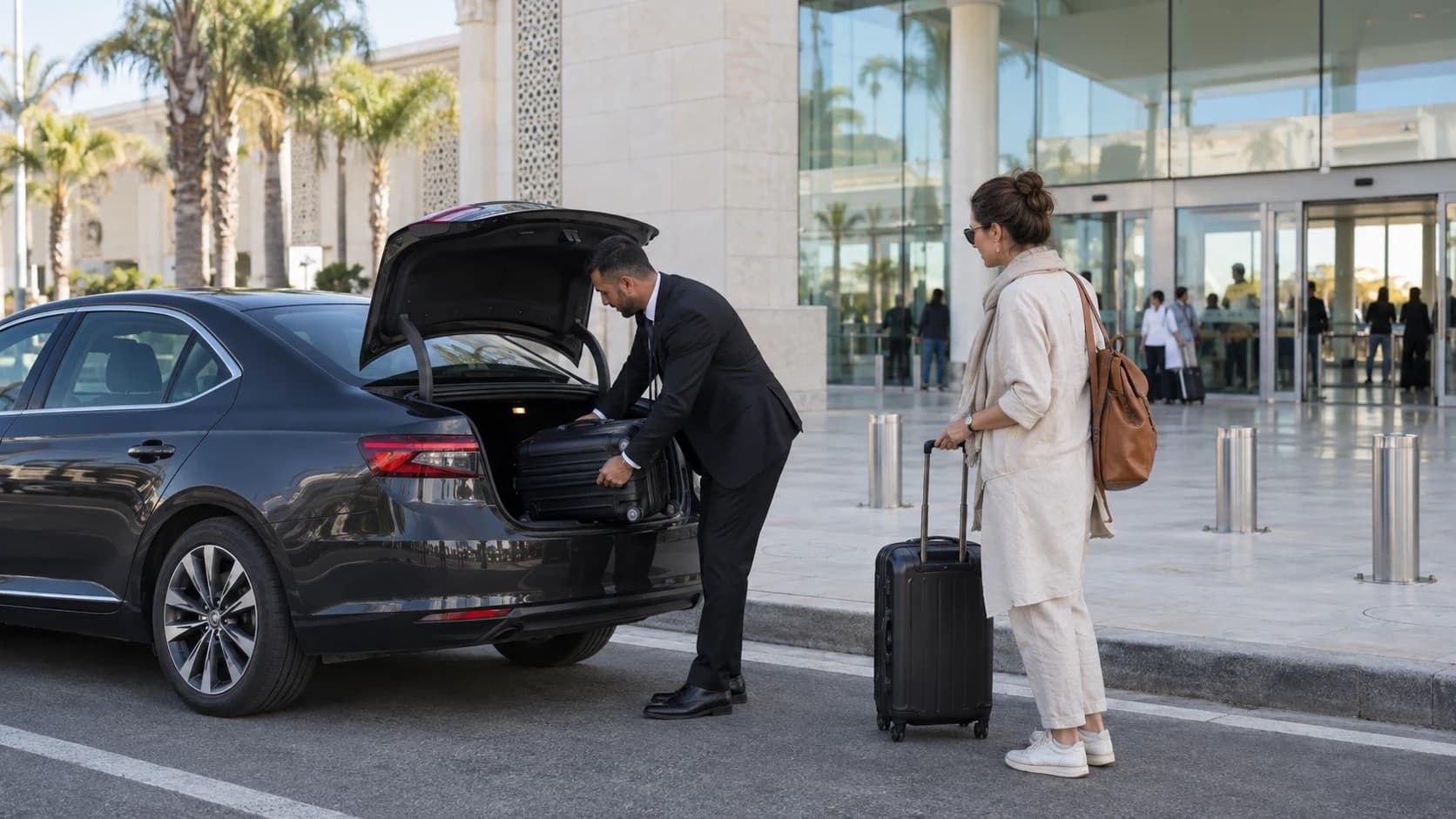
With a pre-arranged pickup, the meeting instructions can be agreed before the flight. Depending on the operator, the driver may meet you in the public arrivals hall holding a sign with your name.
A good booking confirmation should explain the exact meeting point, the vehicle capacity, the total price, the payment method, and what happens if your flight is delayed.
For example, TransfersTangier is a local private transport service that arranges airport pickups and journeys around northern Morocco. Its pickup arrangements include flight tracking and meeting passengers in the arrivals hall with a name sign.
Pre-booking isn't essential for everyone. If you're traveling alone and only need a straightforward ride into town, an official airport taxi may be perfectly suitable.
But having a driver arranged beforehand can make sense when you're arriving at an unfamiliar airport after a long day of traveling.
Option 3: Car rental
Renting a car can be useful if you plan to explore northern Morocco independently.
It gives you flexibility to visit places such as Asilah, Tetouan, Cap Spartel, and the surrounding coastline without arranging separate journeys.
However, a rental car isn't always necessary if you're spending most of your time in central Tangier.
Parking can be difficult around busy areas, and many streets in the old Medina are not suitable for cars.
If your accommodation is in the historic center, ask about parking before booking a vehicle.
Option 4: Public transport
Public transport can be the cheapest way to travel, although it may not always be the most convenient option with luggage.
Tangier's local transport network has developed over time, so check current airport bus services, stops, and operating hours before relying on a particular route.
If you're arriving late at night, it's especially important to check whether your preferred service is still running.
For most first-time visitors, the decision comes down to cost, luggage, arrival time, and how easily their accommodation can be reached.
4. Staying in the Medina? Read This Before Booking Your Ride
One of the things visitors sometimes overlook is that Tangier's Medina is very different from the newer parts of the city.
The old town is full of narrow streets, stairways, traditional houses, little shops, and pedestrian areas.
That's part of what makes it special. It's also why being dropped directly at your accommodation's front door isn't always possible.
If you're staying in a riad or guesthouse inside the Medina or Kasbah, your driver may need to stop at a nearby vehicle-accessible entrance.
Common reference points include Grand Socco, Bab el-Fahs, and accessible approaches near the Kasbah, depending on where the accommodation is located.
From there, you might have a short walk to reach your riad.
Some accommodations can arrange for someone to meet you at the entrance or help with luggage.
The best thing to do is ask your accommodation one question before arrival: "Where is the easiest place for a taxi to drop us off?"
That single message can save you from wandering through small streets with suitcases, trying to find a property that looks much closer on the map than it feels in real life.
5. Understanding Tangier's Main Neighborhoods
Tangier isn't one single tourist district. Where you stay can change the experience quite a lot.
The Medina and Kasbah
These are the historic parts of Tangier, with narrow streets, older architecture, small cafés, and traditional accommodation.
They're good choices if you enjoy walking and want to spend time exploring the city's older character.
The main disadvantage is vehicle access. Depending on the accommodation, you may have to walk from the closest road.
Grand Socco
Grand Socco is one of the best-known meeting points in the city, located close to the Medina.
It's useful as a reference point because it connects the old town with the surrounding urban streets.
If you're meeting a driver or arranging a pickup near the Medina, it can be easier to agree on a recognizable point around Grand Socco instead of giving directions through the smaller lanes.
Ville Nouvelle
Tangier's newer central districts have wider streets, shops, restaurants, hotels, and more conventional road access.
For travelers who want convenient transport and modern accommodation, this area can be a practical choice.
Malabata
Malabata is on the eastern side of the city, around the coastal hotel districts and roads leading away from central Tangier.
You'll find modern hotels, apartments, and sea views in parts of the area.
Travel times from the airport can vary depending on which part of Malabata you're visiting.
The Corniche and Marina
The seafront is popular for walking, having coffee, and enjoying views of the bay.
Tangier's marina and nearby waterfront have changed considerably over the years, and the area is particularly pleasant for an evening walk.
If this is your first visit, it's a good place to get a feel for the modern side of the city.
6. Tangier Has More Than One Port — Don't Mix Them Up
This is an important detail, especially if you're arriving by ferry or continuing your journey by sea.
Tangier has two very different port locations.
Tanger Ville Port
Tanger Ville is close to central Tangier, near the Medina and marina.
It's convenient for visitors who want to reach the city without a long road journey afterward.
If you have accommodation in the Medina or central Tangier, this port is usually much closer.
Tanger Med Port
Tanger Med is a large port complex located well outside the city, east of Tangier.
It's a major passenger, commercial, and logistics port.
A transfer between Tanger Med and central Tangier is a substantial road journey, not a quick trip around the corner.
This distinction matters when booking accommodation, arranging a driver, or planning a ferry connection.
Always check the exact port written on your ticket. Booking transport to Tanger Ville when your ferry actually arrives at Tanger Med can create a very inconvenient situation.
Also check your ferry operator's arrival and departure instructions, particularly when traveling with a vehicle.
7. Going Straight from Tangier Airport to Another City
Not everyone who lands in Tangier plans to stay there.
The airport is also a starting point for exploring northern Morocco.
Here are a few of the most common destinations.
Chefchaouen
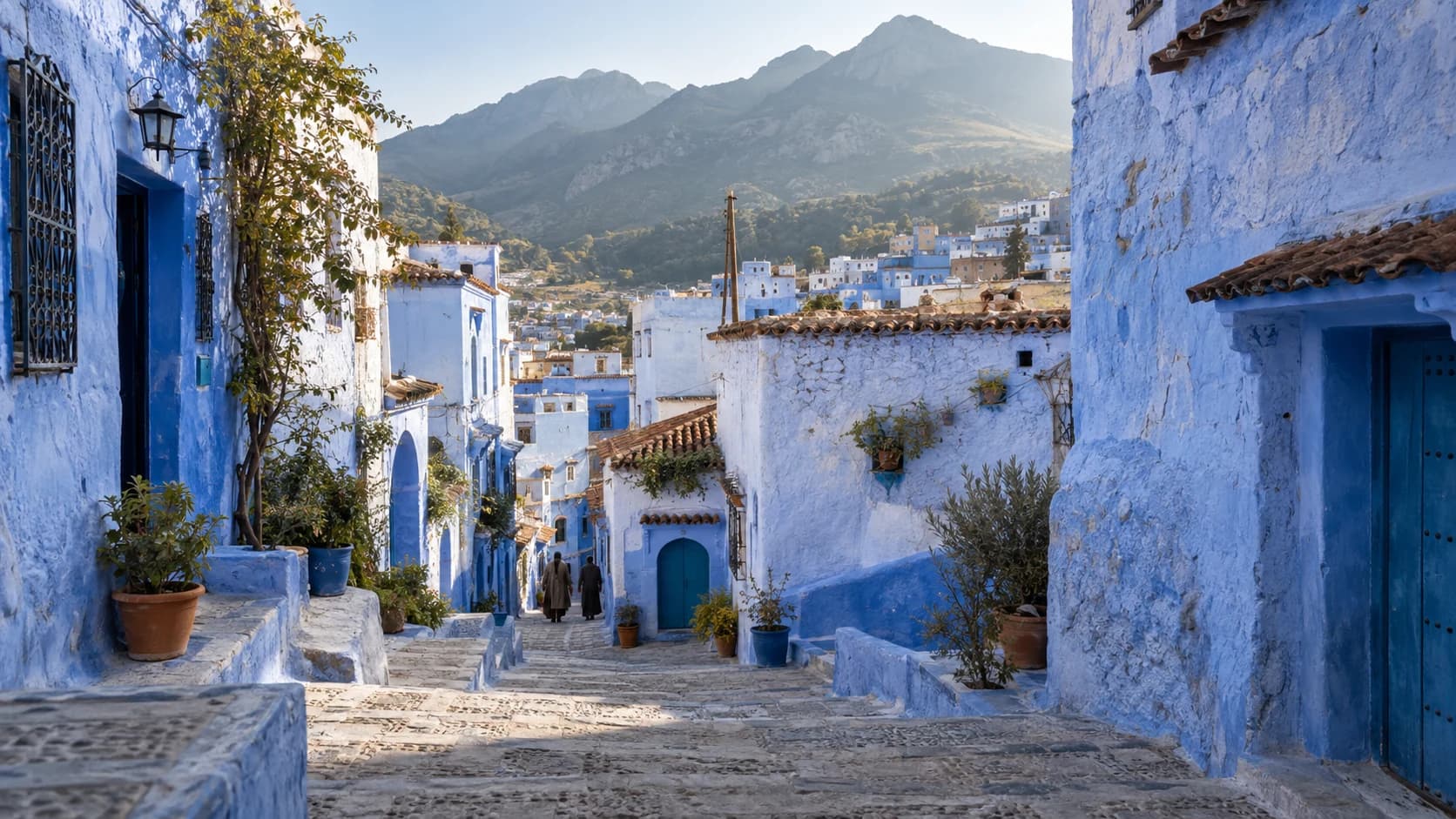
Chefchaouen is famous for its blue-painted streets and mountain setting.
From Tangier Airport, the road journey usually takes roughly 2½–3 hours, sometimes longer depending on traffic and conditions.
If your flight arrives early enough, it's possible to continue directly to Chefchaouen rather than spending the first night in Tangier.
But remember that Chefchaouen's old town also has narrow, pedestrian-only streets.
If you're staying inside the Medina, confirm where vehicles can stop and how you'll reach the accommodation.
Tetouan
Tetouan is closer to Tangier and has a beautiful historic Medina of its own.
The drive from Tangier Airport generally takes around one hour to one hour and fifteen minutes.
It's a useful destination for visitors who want to explore the cultural and historic side of northern Morocco, or who are continuing toward the Mediterranean coastline.
Asilah
Asilah is a coastal town south of Tangier, known for its whitewashed streets, historic walls, and relaxed atmosphere.
It's one of the easiest places to visit from Tangier and is popular for day trips.
The drive from the airport is often around 30–45 minutes, depending on your exact destination.
If your schedule allows, Asilah can be a pleasant first stop before continuing through Morocco.
M'diq and the Tamuda Bay Coast
The Mediterranean coast east of Tetouan is popular in warmer months.
M'diq, Fnideq, and the Tamuda Bay area have beaches, hotels, resorts, and seaside restaurants.
The area feels quite different from Tangier's Atlantic-facing coastline.
If you're heading directly to one of the resorts, make sure you provide the exact hotel name rather than just saying "Tamuda Bay," as the area stretches across several locations.
Fez
Fez is further away and requires a longer journey.
It's home to one of Morocco's most famous historic Medinas and is popular with visitors planning a longer trip through the country.
If you're arriving in Tangier after an international flight, think carefully about whether you'd prefer to continue straight to Fez or spend a night in Tangier first.
A long drive after a tiring flight isn't always the most enjoyable way to start a holiday.
For travelers planning longer routes, a service such as Tangier airport transfers can be arranged in advance, particularly when traveling with family or several pieces of luggage.
Whatever transport you choose, allow extra time if you're connecting to another flight, ferry, or train.
8. A Simple Plan for Your First Day in Tangier
If you've never visited Tangier before, you don't need to fill your first day with activities.
A relaxed introduction is often better.
After checking into your hotel, start with a walk around the Medina or Grand Socco.
Stop for a coffee or mint tea and take some time to explore the small streets.
If you're hungry, try a local restaurant serving Moroccan dishes such as tagine, grilled fish, or harira.
Later in the day, head toward the Kasbah for views over the city and the Strait of Gibraltar.
If you still have energy, finish with a walk along the seafront.
There's no need to rush between attractions. One of the nice things about Tangier is simply spending time in different parts of the city and seeing how they fit together.
If you're staying longer, there are several places worth visiting outside the center.
Cap Spartel
Cap Spartel is a scenic headland west of Tangier, with a lighthouse and views toward the waters where the Atlantic meets the Mediterranean region.
It's especially pleasant on a clear day.
Rmilat and Perdicaris Park
Rmilat is a green, wooded area with walking paths and views of the sea.
It's popular with local residents looking for somewhere peaceful to walk, exercise, or enjoy the outdoors.
Hercules Caves
The Hercules Caves are located near the Atlantic coast, not far from Cap Spartel.
They're a well-known attraction associated with local legends, and visitors often combine them with a trip along the coast.
Opening arrangements and admission charges can change, so check before going.
Achakar Beach
Achakar is on the Atlantic side of Tangier, close to the Hercules Caves.
It's a nice place to stop for coastal views, although the weather and sea conditions can change quickly.
These places can be combined into a half-day outing, leaving you plenty of time to explore the city itself.
9. Common Mistakes First-Time Visitors Make
Most arrivals in Tangier go smoothly. Still, a few small mistakes can cause unnecessary inconvenience.
Not checking which port they're arriving at. Tanger Ville and Tanger Med are completely different locations.
Assuming every hotel has direct vehicle access. This is particularly common with Medina riads.
Arriving without the full accommodation address. Keep a copy on your phone, ideally with the contact number.
Planning a tight connection immediately after landing. Passport control, luggage collection, and traffic can all take longer than expected.
Not confirming the price of transport. If a fare hasn't already been agreed, ask before starting the journey.
Assuming every driver accepts cards. Having some local cash is a useful precaution.
Trying to see everything on the first day. Tangier is much more enjoyable when you leave some room for wandering, coffee breaks, and unexpected discoveries.
10. A Few Useful Things to Know About Tangier
What languages are spoken?
Moroccan Arabic, commonly called Darija, is widely spoken.
You'll also hear French and Spanish, particularly in tourism-related businesses.
English is used in many hotels and tourist services, although not everyone speaks it.
Learning a couple of simple words can be helpful.
- Salam — Hello
- Shukran — Thank you
- Afak — Please
- Bshal? — How much?
Don't worry if your pronunciation isn't perfect. A friendly greeting is usually appreciated.
Is Tangier walkable?
Many central areas are walkable, especially the Medina, Grand Socco, and parts of the seafront.
However, Tangier is quite hilly in places. Some streets involve steep climbs or stairs.
Comfortable shoes are a very good idea.
For longer journeys between districts, you may prefer a taxi or another form of transport.
What's the weather like?
Tangier has a coastal climate.
Summers are generally warm, while winters can be cooler, wetter, and windy.
Even on sunny days, the wind can make the coast feel cooler than expected.
If you're visiting outside summer, bring a light jacket. It can be useful for evenings, ferry crossings, and exposed coastal viewpoints.
Can I drink tap water?
Water quality and individual tolerance can vary. Many visitors prefer bottled or properly filtered water, especially during a short stay.
If you have a sensitive stomach, it's sensible to be cautious.
Is Tangier suitable for families?
Yes. Many families visit Tangier and the surrounding region.
The main things to plan are transport, walking distances, and luggage.
If you're traveling with a baby or young child, check child-seat availability before booking a vehicle.
If you're planning a day trip, it's also worth building in extra stops rather than trying to cover too much distance in one day.
11. A Quick Arrival Checklist
Before your flight:
- [ ] Save your hotel address and phone number
- [ ] Confirm whether your accommodation is accessible by car
- [ ] Check your passport and Morocco entry requirements
- [ ] Arrange mobile internet or an eSIM
- [ ] Decide how you're getting from the airport to your hotel
- [ ] Confirm transport prices and meeting instructions
- [ ] Keep your flight number and booking details accessible
After landing:
- [ ] Complete passport control and collect your luggage
- [ ] Connect your phone to the internet
- [ ] Get some dirhams if needed
- [ ] Contact your accommodation or driver if necessary
- [ ] Check the vehicle or taxi details before departing
- [ ] Keep your belongings together and enjoy the journey into Tangier
Final Thoughts
Tangier is a city that's easier to enjoy when you arrive with a little local knowledge.
You don't need an elaborate travel plan. Knowing where your accommodation is, how to leave the airport, and which parts of the city are accessible by car is already a good start.
Whether you choose an official taxi, a rental car, public transport, or a private driver, the important thing is choosing what makes sense for your arrival time, budget, and destination.
And once you're settled, make time to enjoy Tangier itself. Walk through the old streets, stop for coffee, spend an evening by the sea, and don't feel obliged to rush off to the next city.
There's much more to Tangier than its airport.
About this guide
This guide was prepared by TransfersTangier, a local private transport service based in Tangier, Morocco. The information is intended to help visitors plan their arrival and travel around northern Morocco. Travel times and prices may change depending on traffic, season, and local operating conditions.
For official airport information and updated taxi details, visit the Moroccan Airports Authority (ONDA).
Frequently asked questions
Which ferry port should I use in Tangier?
Check the port name on your ticket and follow your ferry operator's instructions. Tangier Ville and Tanger Med are separate ports.
Can a car drop me at my Medina riad?
It depends on the street. Many Medina lanes are pedestrian, so ask your host for the nearest vehicle-accessible entrance and agree on a drop-off point.
Should I travel to another city as soon as I land?
Consider your arrival time, drive length, energy after the flight and the next accommodation's check-in. Staying overnight in Tangier is one option if you want a slower start.

Plan your airport pickup
Send your flight, destination and group details. We’ll confirm your vehicle, fixed fare and meeting point before you book.
Flight tracking · Meet inside arrivals · WhatsApp support 24/7Have a question about this guide? Contact us.